05 July 2012

Other Minimal Shoes

My minimal trip through shoeville continued with further purchases for more "everyday" wear, and a continuing search for cross training shoes (which I've just about given up).


I bought a pair of Soft Star Shoes for winter wear.  My biggest issue with VFFs is that my ankles were getting cold.  I wanted shoes I could wear socks with.


So I ordered my Soft Star Original RunAmoc in smooth leather, size 8.5 as per a conversation with Soft Star (they were really helpful).  My only complaint about them is the width.  They are hugely wide, especially in the heel.  I've caught my shoe on stuff walking/jogging/jumping around my house, that I have never caught shoes on before (like the dogs' water bowl as I hopped around it).  And it is all due to the excessive width.  Since these are unisex, I suppose the width makes sense.  However, I have a B width forefoot, and probably a slightly narrow heel, so these are sloppy, sloppy, sloppy. 


Those "Original RunAmocs" are heading to the donation pile, because I got much better SoftStar shoes.  The above are a lovely size 9 narrow sheepskin lined Ramblers.

http://www.softstarshoes.com/adult-shoes/rambler-nutmeg.html

Oh, ah!  They fit so much better.  I no longer feel as though I am wearing too big hand me downs.

As per SoftStars measuring table, I am the small side of their normal width.  Being that I just so happened to catch their spring sale, and they had two narrow size 9s up, I bought them both.  A subsequent purchase or two on another sale netted me two more 9 narrows, and I wouldn't buy another normal width SoftStar ever again.

I am quite happy with close fitting, though not tight shoes.


I am now the happy owner of two pair of RunAmocs: black and chocolate - both narrow size 9s.

http://www.softstarshoes.com/adult-shoes/dash-runamoc-all-smooth-black.html


And my last (latest?) SoftStars are one single pair of Merry Janes, also size 9 narrow.
http://www.softstarshoes.com/adult-shoes/merry-jane-chocolate.html


An actually cute, no foolin' pair of girly minimal shoes.  Bronze leather.  There are, however, two issue with these: lining and velcro.

Lining -  Holy blackened feet, Batman! The lining dye's my feet every wearing ... each and every single time.  Not something I can comfortably slip off and go barefoot after a couple hours use.  I look live I've got a serious fungal infection.  Yes, it does wash off, but yuck!

Velco - This is a minor quibble, and due mostly to old fashioned opinions and a high instep.  The strap is held on by a length of velcro sewed to the side.  You can see it in the bottom most picture.  And that is my problem, velcro is for kid's shoes, and my shoes should not show velcro!  If the bit sewn on the shoe was shorter, it would not be an issue as it would not be visible.  Still, very comfortable.


SoftStar is now offering several of their shoes in a narrow without charging extra, but there is still an additional charge with narrow Merry Janes.  I think it is worth it.


After all of this rigamaroll, I still didn't have anything for aerobics, since I don't actually work out in my Soft Star shoes, those are my nice shoes!


So I purchased three minimal-ish running shoes.


The Ecco Biom, Women's size 41, (another awesome discount sale), and I do not like them.  They do not feel right, nor do I like to run in them.  They have spent the majority of their wear time as walking shoes on vacation.  If they weren't such a pretty color, I'd donate them.

Additionally, they are wearing quickly, so I do not expect them to last long.  They have less than 100 miles on them, and I'm not sure they will make it to 200.


The Vivobarefoot Neo (sale), Women's 42, and I do not like these either.  I've hardly worn them ... which is a good indication that they need to visit Goodwill.  I feel like I am strongly inverting when I wear these, an extraordinarily disconcerting sensation.


Finally, the Saucony Kinvara 2.  These work very well for running, but very poorly for aerobics.  These have a lot of width stabilization built into the sole, which makes for a trippy (literally) experience when trying to perform any kind of side kicks, grapevines, or box steps ... especially when tired and coordination goes flying out the window. 


Behind my VFF KSO Treks, this is probably my second favorite running shoes.

When I read about Micah True having disappeared on a run and rescuers were looking for the triangle shaped imprints from soles of his shoes, I suspected he was weary a Kinvara.  Finding out he had a relationship with Saucony kind of confirmed the impression.  A strange result that, "Hello, I represent Saucony ... yes, the ultrarunning Micah True was wearing our shoes when he died."  It was a sad day when that legendary heart gave out, he had a remarkable story to tell!


So to conclude this long journey, SmartWool Toe socks turned my 0 to 30 minute exercise only VFF KSO Treks into 80 minute plus cross train and running shoes and winter shoes.  Thank goodness for woolen socks.  :)

Why is "Yoga" bad for "Runners"?

I remember reading a short conversation in "Born to Run" (BTR) regarding yoga and running.  I believe a coach or trainer comments that yoga is bad for runners.  And that is as far as they got.

I was insulted, truly.  I enjoy yoga on occasion.  It is amazing how flexible it can make you with regular practice, and I could not figure out why anyone would say yoga and running do not mix. 

Not until reading "Runner's Body" (RB). 

http://www.rwrunnersbody.com/uof/rwrunnersbody/?keycode=097308


Let me clarify the bomb dropped in BTR ... yoga, and especially extreme yoga, may not be the best for a long distance runner trying to increase speed and/or distance.  It is the breakdown of energy use that RB pinpoints, and how joint health and mobility impacts running.


To start out, let me give you a little anatomy lesson: there are three stabilizing factors involved with all moveable joints: the shape of the bone tips that move together and create the joint (think elbow, knee, hip, etc), the ligaments that wrap around the joint (think about a twisted ankle and the swelling involved), and the muscles that reinforce and surround that same joint (think about how much stronger you get doing planks, almost pure muscle work).


The articulating surfaces of the shoulder joint are the head of the humerus and the glenoid cavity of the scapula.


 The articulating surfaces of the knee joint are primarily the distal head, or condyles, of the femur and the proximal head, or condyles, of the tibia.


It may be a bit easier to picture in this flexed knee picture, where the condyles of the femur (covered in protective cartilage) are very easy to see.


The articulating surfaces of the hip joint are made up of the deep socket of the pelvis, the acetabulum, and the ball of the femur that fits rather neatly (usually) into the acetabulum.


For the most part, we cannot do much about the bone tip shape (it is genetically programmed) and generally holds us in good stead unless disease, such as arthritis, causes the shape to change.  Some of our joints have a shape that lock it out at certain extension angles (fingers, elbow), while other joints allow a remarkable range of motion (shoulders, hips).


Ligaments attach bone to bone, and stabilize joints.  The shoulder joint is fairly shallow as far as the bone structure is concerned, and therefore the ligaments have a very important job in stabilizing the shoulder joint.  If you ever pop the shoulder out of joint, you stretch the ligaments, which cannot return to their original, pre-stretched state.  It is that much easier to pop the joint out of place next time.


The knee joint is heavily surrounded by ligaments that do their best to stabilize this strange joint (our patella is such an interesting evolutionary adaptation IMO).  There are, in fact, three bones involved in ligamental attachment: femur, tibia, and fibula.  


This hip joint is also a "ball and socket" like the shoulder.  However, it is much more stable due to the depth of the acetabulum (much deeper than the glenoid cavity).  So the ligaments do not have to work quite as hard to keep the joint stable in the hip as they do in the shoulder. 

Much like the articulating surfaces, we cannot do much to "strengthen" our ligaments, but we can stretch them out.  With age and injury, we replace damaged tissue with scar tissue, which is remarkably strong, but with little stretch.  So we need to be careful of our ligaments, stressing them enough, but not too much. 


Our musculature is kind of like the layers of an onion.  The smaller muscles are in towards the center (usually) while the larger muscles wrap around the entire structure on the outside.  The three above photos show the superficial human musculature, and generally the biggest and strongest muscles.


These two pictures are some of the deeper muscles that stabilize the shoulder, they are much smaller than the superficial muscles.  It is the smaller muscles that are easy to damage, and damage badly, because we have other muscles that can compensate.


Finally we come to the root of the problem, musculature of the joint.  We can strengthen muscles quite easily.  Though again, like the ligaments, we want to push just hard enough, but not too hard.  We can also stretch muscles.  And this is what yoga does, it takes someone who has a set amount of flexibility and increases that flexibility, often by stretching the muscle (and to some extent the tendon that attaches that muscle to the bone).

This is the rub.  How many flexible runner's do you know?  Many runner's I've seen are, in fact, extremely inflexible.  Their joints have a very limited range of movement.  Have those runner's take a couple yoga classes, and their joints gain greater flexibility.

However, this very flexibility slows a runner down, and it all has to do with energy expenditure.  Once the joint gains greater flexibility, the muscles have to work harder to keep the joint within a certain range of motion in running.  By the muscles performing extra work in joint stabilization, there is less energy available for distance and speed. 

Is it going to have an impact on most runners?  I doubt it will be noticeable.

Is this going to up your injury likelihood?  No, I do not think so.  (However ... you can injure yourself in yoga by pushing your joints too far just like you can injure yourself in running by pushing yourself beyond your limits.)

Regular yoga for a runner does mean you will not be able to go as far as fast. 

Think of it as multitasking ... before yoga, the runner's joint could only do one thing, run.  After yoga, the joint is more flexible, and can handle a greater number of tasks.  But, it may not be able to do any one task exceptionally well.

I see runner's having several yoga options with this insight: 1) stop asking your joints to multitask, i.e. give up yoga, 2) stop worrying about the loss of a couple seconds in a run, i.e. enjoy all aspects of yoga, or 3) stop asking your main running joints to multitask, i.e. do not deeply stretch the hips and knees.

If you want to be a well rounded athlete, I think options 2 or 3 are the best.  If you are experiencing massive time loss after all those hip opening exercises, don't push your hip joints so much, let them stay a little stiffer.  Work on upper body strength exercises, instead. 

If you are trying to shave time off your PR in marathon, or "in the running" (ha, ha) for an Olympic medal, perhaps you would do better with option 1.

30 June 2012

Minimal Shoes ... VFFs

WARNING, WARNING ... old, worn, thoroughly used shoe photos ahead.  These are not nice, neat, nor brand new shoes in the following photographs.  For the sensitive, avert your eyes ...


I can guarantee you one thing with a transition to "minimal shoes" ... you will learn proper exercise form, or else.  :)

I transitioned to approximately half my time in minimal shoes in late 2011.

I had seen Vibram Five Fingers (VFFs) for several years, and thought they looked a bit silly.  However, everything I read on them was intriguing and, since I happened upon a sale anyway, I decided to try a pair out.

FYI - For me personally, I don't have any trouble putting VFFs on, I find it easy to figure out where my toes go, and they slip on practically like slippers after all this time. 


Here are my first and favorite VFFs, the KSO Trek in kangaroo leather.  They fit my foot beautifully, and this is the only shoe I would wear if they were a touch more "acceptable."  I ordered them in a size 40 as per fitting recommendations.  This is my European shoe size.  In "American" shoes, I generally wear a women's 9.5B dress shoe or a 10B in athletic shoes.

My only problem?  I wish they reversed the velcro.  I cannot wear longer pants with these as the fabrics catch in the exposed hook side due to my high instep.

I will say, this is not your father's kangaroo leather, it is not stinky or thick, but supple and easy to deal with.  So far, I have not experienced the VFF funk I have read about on other forums.


I enjoyed the KSO Treks so much, that I ordered a second pair (also on sale), Jaya LRs in Almond/Copper color: size 41 (as per fitting recommendation).  These are like slippers, and they are my *only* house shoe for spring and fall.

I had two problems with these.  First off, they are a bit tighter in the pinky toe than the KSO Treks, and I fell asleep in them my second wearing.  When I woke up my pinky toes really hurt!  Ouch.  Moral of this story, don't fall asleep in new VFFs!  :)  They have since stretched out with wear, and I have fallen asleep in them several additional times without pain upon waking.

Second issue, since these have stretched out quite a bit, I cannot workout in them.  Hence the reason they are house shoes only.


My third pair of VFFs were the Performa Jane, size 41, which I absolutely love.  I wish they had a less wear-away base, because these would not last long on concrete.  They are great weight lifting, house, and relaxing shoe.  I don't expect them to have the longevity I would prefer.  I wish they came in a wider range of colors ... psst, Vibram FiveFingers, Give us warmer colored girls something to wear, wouldja?


My fourth pair of VFFs were the Sprint, size 41.  I strongly dislike this shoe.  If I had started with these, I would not have a good impression of VFFs and may never have purchased another pair.  I got these for aerobics because the tread on the Treks are too aggressive for slipping and side to side motion ... a basic requirement of kickboxing.  These are the shoes that taught me the lesson at the beginning of this post.  I get more numb toe issues with these VFFs than any other pair of shoes I've ever worn.  I also had to do major surgery to these to make them halfway wearable by slicing the elastic at the heel.  Surgery did not improve them enough to make them wearable.

I usually wear my shoes into the ground before I replace them.  These are not going to make it that far.  I have considered, more than once, turning them into: dog toys or trash dwellers.

Moral of this portion?  If you have tried VFFs and had a bad experience but like the idea of the shoes, you might consider another style.  Because the style you picked may have been bad for you, not necessarily the entire line.


But I still had issues with my KSO Treks, I have hot spots develop when doing cross training movements.  TaDa ... SmartWool Toe Socks ...


Yeah, KSO Treks dye my socks pretty badly.  I've never had the KSO Treks dye my feet when worn without socks ... but I suspect leather and wool dye have many similarities in property, and I'm just glad the dye issue stops with my socks.


Something I figured out pretty early on, when putting on the socks, pinch a quarter of an inch or so beyond your toe.  If the socks are pulled on really tight, exercise could tighten them more and dig into the soft tissue between your toes.


And here we are ...


No more hot spots, no more blisters, regardless of how much horizontal stress movement I place on my feet.  Good thing too, since I haven't found anything that works as well as my VFF KSO Treks.  I hope VFF brings back the kangaroo leather soon.

Exercise and Running clothes ... the top side

I started out wearing my cotton exercise clothing for working out ... cotton shorts, cotton yoga pants, cotton yoga tops.  I like cotton, most of the time, and it had worked out well for all of my previous forays into exercise.

But ...

I started developing "issues."  Let us just say a little "chafing of the cheeks" and leave it at that.

So I began looking for alternatives that wick sweat and dry quickly.  I pulled out my simple Ibex bra, and ran in that.  Wow, what a change from sticky, heavy cotton (regardless of the fact that cotton starts out lightweight, it quickly droops with sweat).


Since my Ibex bra did so well, I bought two more.

Ibex's Balance Light Bra

This is not recommended for high impact activities, and it was originally purchased as a travel bra since I would not have to wash it much (it performed very well on vacation).

For me, it also performs well as a running, walking, aerobics, and weight lifting top.  Being that my body type does not store much body fat above the waist, I am not overly endowed in the chesticles department.  As such I have no fear of falling out, nor of pain, as a result of enthusiastic movement within the confines of this article of clothing.

I highly recommend it for B cups and smaller for anything you desire to do within it.

Granted, in aerobics, I do hear what little arm fat I have cheering me on as it flaps against my rib cage, but that it NOT the fault of the bra!


Ibex's Balance Sport Top

Since I enjoyed my bra so much, I decided to try the Sport Top.  I'm not likely to go out in company with my belly exposed - it does not get sun, it is a bit flabby, and I just would not be comfortable saying "Hey world, can you guess how much body fat I carry by looking at my abs?"

I did find the low side cut a bit disconcerting the first two or so times I wore it, but I've quickly gotten used to it and would not want it any other way.  I currently have two.  They can get a little warm in extreme heat, but I'm quite comfortable in anything at or under 80 degrees F.


I do have a variety of tank tops from Smartwool and Icebreaker, but prefer to use them in "nice" outfits rather than as exercise clothes. 

Exercise and Running clothing ... the bottom side

I started out wearing my cotton exercise clothing for working out ... cotton shorts, cotton yoga pants, cotton yoga tops.  I like cotton, most of the time, and it had worked out well for all of my previous forays into exercise.

But ...

I started developing "issues."  Let us just say a little "chafing of the cheeks" and leave it at that.

So I began looking for alternatives that wick sweat and dry quickly.  So I pulled out my old "old, old" pair of running shorts in nylon.  They worked, but they were too big, shifted everywhere, and just felt strange.  I am not a fan of most synthetic fabrics, they feel off to me.  They make my skin rebel.

Right about this time of my discomfort, winter sales are occurring, and I check out my favorite wool companies: Ibex, Icebreaker, and Smartwool.  Gak!  Wallet attack!


Into my exercise world crept:
http://www.backcountry.com/stoic-merino-boy-boxer-womens

Stoic Merino Boy Boxer - Hands down the most comfortable boxer I've ever worn.  It stays in place, does not creep much, and can handle a couple of miles of sweat.  I started out with a large, which has become a bit too large for exercise (as it now creeps where it once did not) so I've also ordered a medium.  The larges are now sleep and goof around shorts while the mediums are my exercise short.

I would gladly have an entire wardrobe of these shorts.  They fit the pear shaped saddle bags well.  I would not recommend these for straight up and down types, as they do have quite a bit of shaping to them.  Thank goodness Stoic came up with these, the only boy shorts made for curvy women!


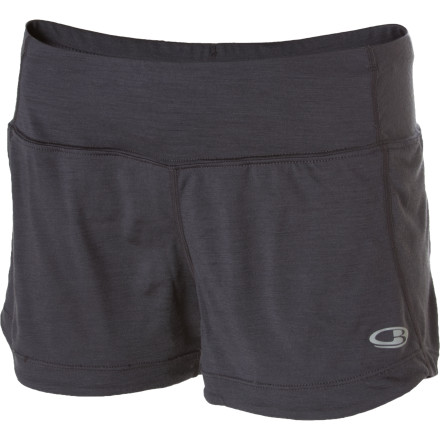
Icebreaker's Swift Short

These are last year's model, and my favorite.  They are a bit tighter in the waist, so I do not have to bother with a drawstring.  A good compromise between too loose and too tight, they dry quickly and are the shorts I reach for most often.


Icebreaker's Dart Short

I got these because of a spring sale, and since I loved the Swift short so much, expected to like these as much.  These are looser in the waist, which means the drawstring is much more important.  They aren't going to slide off, but when I'm doing abdominal work they do gape abominably on my abdominablies!

They do work well for running and walking.  Another good mix of loose, but not too loose.


 Icebreaker's Boyshort

These seemed like such a good pair of shorts when I first got them, but their fit gets worse and worse as time passes.  I would not do aerobics in these now since they creep.  I infinitely prefer the Stoic Boy Short for my curvy body.


Icebreaker's Run Skort

Honestly, I got these for a lark.  Running shorts aren't the most attractive, and I thought these would do well when in company (I usually exercise alone and at home, so it doesn't matter what I wear).  They were a "girly" compromise.

I would not wear these for cross training or weight lifting, as the split irritates me.  However, for simple running or walking they work quite well.

I find the short liner inside quite comfortable, and it does not ride up badly.  I purchased these rather than the Ibex run skort due to the price difference, and am quite happy with them.

They do not get much use because: 1) I'm not outside much during the summer, and 2) I'll reach for the Swift's or Stoic's first.

29 June 2012

Beginning to Run ... at 30-some ... 'ting

At some point in my early 30s, I decided to take up a running program.  Although, I'm not sure you can call it a program, per say.  It has been intermittent, and I change things up all the time.  So I'm not settling into any set schedule, but run as I wish.

I think I can blame it all on the treadmill.  My hubby decided to buy one after a discussion with his doctor.  It went something along the lines of, "You need regular exercise, or else."  I think he was one of those guys that could have been teetering along the lines of a fat skinny person.  Healthy on the outside, and nothing but potato chips on the inside.

So into our world comes a PaceMaster foldup treadmill.  It fit our requirements: maneuverable, no foot tripping handles/gripping bars attached at or near the belt surface, and simple electronics to reduce possible service issues.


                               Thanks to http://www.fitnessrepairplus.com for the jpg.


Our PaceMaster has been running consistently for well over a year now.  I'd say it gets used five days out of seven, sometimes twice a day.


Along with weight lifting and aerobics, running has become a regular part of my routine.  This has led to a remarkable numbers of shoe and wardrobe changes for comfort.  Not to mention the wardrobe updates required for size change.  


And, as always, a rather large number of books have "run" through my reading list.  These include Christopher McDougall's "Born to Run" (of course ... and recommended), Dean Karnazes' "Ultramarathon Man" (pretty amazing story, and a fun read, recommended), Runner's World Complete Book of Women's Running (not recommended, what a waste of paper), Scott Rigsby's "Unthinkable" (not to discount his fight against adversity, but a repetitive, tiring read, not recommended), Runner's World The Runner's Body (by far the best book, highly recommended), and Jason Robillard's "The Barefoot Running Book" (recommended).


Book of Women's Running addressed none of the problems I've puzzled over, nor did it cover women's specific issues unless you count pregnancy as the only issue women runners have in comparison to men.  I was looking more for hip and knee issues due to our angled femurs, and how to identify and correct any problems arising from this physiology.  Nope, simply another "women's power" type books with no substance.  It is not worth the paper on which it is printed.


http://www.amazon.com/Runners-World-The-Body-Exercise/dp/1605298611


The Runner's Body is a recent library borrow, and I'm not even finished yet.  But, it has addressed many of the problems and issues I've encountered or puzzled about.  I wonder what I will learn from the second half of the book?  I think this should be required reading for anyone getting into the running sport or interested in the physiology of the runner's body.


http://www.amazon.com/Born-Run-Hidden-Superathletes-Greatest/dp/0307279189/ref=sr_1_1?s=books&ie=UTF8&qid=1341006615&sr=1-1&keywords=born+to+run

Born to Run was, of course, my introduction to running, barefoot running, and ultramarathons, in particular.  It fired my imagination, and got me thinking about how easy running could be versus how hard I'd experienced it in the past.  I started a lot of shoe change up after reading this, and have finally settled on what works for me.